
MS Access As A Dev Tool
Access continues to be a highly efficient tool for business database development.
 Call (323) 285-0939
 We can also clean up export routines so PDFs and Excel files come out the same way each time, and set up a simple one-click process for your monthly reporting pack. Call (323) 285-0939 for a free consultation.
If your database has outgrown a single Access file, we can keep Access as the familiar front end and move the tables to SQL Server for better speed, reliability, and multi-user stability. Call (323) 285-0939 for a free consultation.
Owner & Principal Programmer: Alison Balter. Alison is a Microsoft Certified Partner and Microsoft Certified Professional, and she was one of the first professionals to earn the Microsoft Certified Solutions Developer credential. She has authored 15 Microsoft Access books and has delivered hundreds of real-world database projects for organizations that depend on accurate reporting and clean data every day.
Most local organizations do not need a full rebuild. They need a small set of changes that make the database behave again. We begin by watching one normal workflow with you, then we trace the slow step to its source: table design, relationships, indexes, and the exact queries behind the screens that lag. If you import vendor files, we set up a controlled import so a new column does not shift values into the wrong fields (see Microsoft’s guide: Import Or Link To Data In A Text File). If multi-user lockups show up, we follow Microsoft’s split-database approach so each person runs their own front end (Split An Access Database). When you need more headroom, we can move the heaviest tables to SQL Server using SSMA while keeping your Access front end (Access To SQL Server Migration Guide). A small but common example: a supplier CSV adds a new “UnitCost” column, and suddenly your imports put costs into the wrong field. We prevent that by locking the mapping and validating the header row before the data lands.

We also create websites designed for speed to display your data accurately, using ASP.NET technology. Fast, secure, and robust, our ASP.NET websites and web applications give you a true business tool for finding and displaying information dynamically on the web.






Access continues to be a highly efficient tool for business database development.
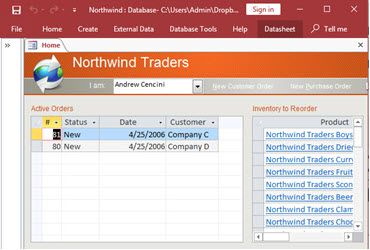
How to create a Microsoft Access application with some unique tips and tricks.
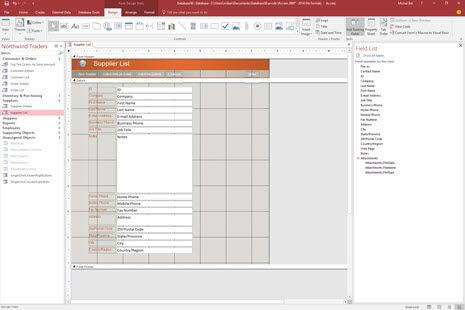
Your Access developer near me has some great info for you about using Access efficiently.
Answer: “Slow” usually points to one of a few repeat offenders: a query that lost an index, a form that opens with too many records, or a report that is doing calculations row-by-row instead of in the query. We confirm where the wait actually happens, then we fix that exact path. One real example we see a lot is a report source that uses domain functions (like DSum/DLookup) on every row. Moving that work into the query often cuts run time dramatically. Once it is responsive, we write down what changed and what to avoid next, so it stays stable as the data grows.
Answer: Absolutely. Older applications can be reliable, but they usually have a few “known quirks” that people work around. We take a safe copy first, compile the VBA, and map the parts that matter most: tables, queries, forms, reports, and automation. Then we translate the real rules into plain language, so the database matches how your office actually operates. A common find is hard-coded file paths or a button that exports to a location that only exists on one computer. Those are quick fixes that remove daily friction without changing how your users do their work.
Answer: A single shared Access file on a network drive is the fastest path to lock conflicts and eventual corruption. The practical fix is to split the database so the back end holds tables and each user runs a local front end copy. Microsoft documents the approach here: Split An Access Database. We also review folder permissions and the network share setup so Access can create and remove lock files reliably. In one small office, moving from “one shared file” to individual front ends eliminated the daily compact-and-repair routine and stopped the random “database needs to be repaired” prompts.
Answer: Yes. A hybrid setup is often the sweet spot: keep the Access front end your people already know, and move the tables that cause timeouts, lockups, or size limits into SQL Server. We usually start with the largest history tables and the queries behind your slowest reports, then migrate and relink in phases so you do not take a big-bang risk. Microsoft’s migration guidance (including SSMA) is here: Migrating Access Databases To SQL Server Using SSMA. One common outcome is that quarter-end reporting stops “freezing” because the heavy lifting moves to the server while Access continues to handle forms and day-to-day entry cleanly.
Answer: We can support Rancho Palos Verdes clients remotely with secure screen sharing, and it is usually the fastest way to diagnose what is happening. We watch the steps that trigger the problem, reproduce it, and then isolate whether the cause is data, a broken link, or a code/reference issue. A very real example after an Office update is seeing “MISSING:” in the VBA References dialog, which can cause buttons to stop working even though the database opens. When deeper work is needed, we take a copy, test changes offline, and then help you roll out an updated front end without interrupting normal operations.
Answer: Yes. Imports and exports are where small inconsistencies turn into big reporting problems. We begin by listing the files your people touch every week (vendor CSVs, Excel sheets, exports to accounting, and any manual copy/paste steps). Then we replace the riskiest steps with repeatable routines, so the same file format produces the same result every time. Microsoft outlines the standard text import options here: Import Or Link To Data In A Text File. A common cleanup is eliminating “seven versions of the same report” by building one trusted report source and one export format that management can rely on month after month.
Answer: You should not be left guessing after the work is done. We deliver a clear summary of what changed, what is new, what was retired, and where the important routines live (backups, imports, exports, and critical reports). If it helps, we add short checklists in plain language so a new hire can run the process without digging through old email threads. We can also do a short screen-share training for the people who own the day-to-day workflow, so questions get answered internally instead of turning into emergencies later.