
MS Access As A Dev Tool
Access continues to be a highly efficient tool for business database development.
 Call (323) 285-0939
 When your Palmdale business is still depending on an older Access file, small issues start piling up. A quote sits in limbo, a report comes out wrong, or two people open the same screen and everything slows to a crawl. We step in, find what is failing, and get it working properly again.
That may mean cleaning up VBA, repairing tables, sorting out imports, or moving the heavy data to SQL Server while keeping the familiar front end. We help companies in Palmdale, Lancaster, Quartz Hill, Acton, and across the Antelope Valley without disrupting how your business runs. Call (323) 285-0939 for quick action.
Some Palmdale companies are still running an Access file that was built years ago and revised over and over. It may still do the job, but people start noticing where it is breaking down when reports slip, imports fail, or your staff stops trusting what they see on screen.
Repair work, VBA updates, better reports, import fixes, Excel conversions, and SQL Server upgrades for databases your business uses every day.
Companies dealing with hand-me-down databases, lag, record conflicts, bad imports, and too many workarounds.
We review the live process first, sort the urgent fixes from the nice-to-have items, and work from a clear plan.
A lot of this work can be handled remotely, which makes it practical for Palmdale, Lancaster, Quartz Hill, Acton, and other Antelope Valley businesses that need help now rather than months from now.
Call: (323) 285-0939
Service Area: Palmdale, Lancaster, Quartz Hill, Acton, And The Antelope Valley
Owner And Access Expert: Alison Balter
Microsoft Certified Solutions Developer (MCSD)
Microsoft Certified Professional (MCP)
Microsoft Certified Trainer (MCT)
Microsoft Certified Partner (MCPa)
Alison Balter, owner and principal programmer of MS Access Solutions, has spent more than three decades building and repairing business databases. She is a Microsoft Certified Solutions Developer (MCSD), Microsoft Certified Professional (MCP), Microsoft Certified Trainer (MCT), and Microsoft Certified Partner (MCPa). She has also written 15 Microsoft Access books and training programs, so the work comes from years of hands-on experience.
That matters when a Palmdale database has been patched for years and nobody is quite sure what is safe to touch. In a lot of companies, the file still runs part of the day even while it is causing headaches, so the repair has to be done carefully. We review what the system is doing, where people are getting stuck, and what absolutely cannot go down in the middle of the week. Then we fix what matters first instead of charging in just because the file looks messy.







Access continues to be a highly efficient tool for business database development.
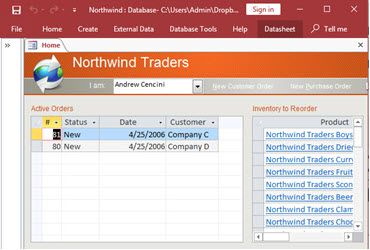
How to create a Microsoft Access application with some unique tips and tricks.
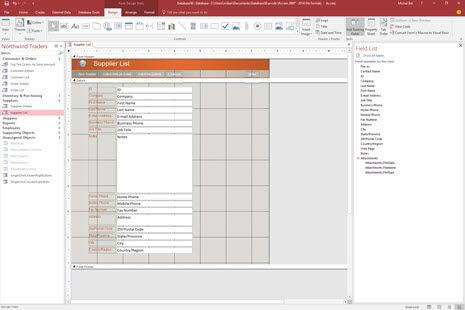
Your Access developer near me has some great info for you about using Access efficiently.
Answer: Usually, yes. A surprising number of older systems are still worth saving. The trouble tends to collect in a few familiar places: one slow query, a front end that has grown bloated over time, an import that nobody trusts, or a form that has been tweaked by five different people over the years.
We normally start with the part that is slowing your people down the most right now. That gives you a clearer picture of what can be saved, what should be repaired, and what is honestly not worth carrying forward.
Answer: A lot of the time, yes. Multi-user trouble is not always one big dramatic flaw. More often it is a stack of smaller issues that finally catch up with the file.
We look at how your people are actually using the system during a normal workday, then fix the parts that are slowing them down in the order that makes the biggest difference.
Answer: Yes, that is often the better option. People get to keep the screens, reports, and workflows they already know, while the heavier data work moves to a stronger back end.
Not every file is ready for that step on day one. Sometimes a little cleanup needs to happen first. Still, for growing companies, it is often a practical way to improve shared use without replacing parts of the system that are already working.
Answer: It is usually not one industry. What these calls usually have in common is that someone in the business is tired of working around the same database problem every week.
We hear from operations staff, managers, accounting people, estimators, and owners. Some are dealing with quoting and purchasing. Others are trying to clean up inventory, compliance logs, service records, or spreadsheet handoffs that have gotten sloppy over time.
Answer: Yes. That is a common call. Once the same spreadsheet starts circulating in several versions, people stop trusting the numbers pretty quickly.
We can bring that process into Access, tighten up data entry, add validation rules, and build reports people can run without hunting through tabs and old copies. In plain terms, it gets the process out of too many spreadsheet versions and into something your people can actually manage.
Answer: No. Most of this work can be handled remotely, and that is how many clients prefer it.
What matters more is the condition of the file and how badly it is slowing people down. We review the database, show you what is wrong, and show you what to fix first and what can wait. That usually means handling the immediate problems first, then taking on structural cleanup or migration work after the dust settles.
Compact and Repair is one of the first things people try when an Access file starts acting strangely. Sometimes that helps. Sometimes it does nothing. In the worst cases, someone runs it again and again on a file that has a deeper problem, and the real issue gets harder to sort out.
We see that a lot with older business databases in Palmdale. The complaint usually sounds simple at first: the file is slow, a form will not open, records look odd, or users start getting messages no one has seen before. By the time we look at it, staff members have often already tried a few quick fixes on their own.
Compact and Repair can be useful when the file has grown larger than it should, temporary objects have piled up, or normal wear from daily use has left things a little messy. It may shrink the file, clean out leftover space, and clear up minor corruption. That is why it has a place in routine maintenance.
Still, it is not a cure-all. If the trouble is coming from bad VBA, damaged linked tables, network interruptions, or a split database setup that was put together poorly, Compact and Repair is only touching the surface. The symptom may ease for a day or two, then come right back.
If a database has started throwing inconsistent errors, freezing with several users, or showing forms that open blank, it is smarter to slow down and inspect the structure first. We want to know whether the front end is bloated, whether the back end has damage, and whether the network path is part of the problem. Running a repair tool before that review can muddy the trail.
One common example is a shared file sitting on a network drive with too many people opening the same objects at once. Another is a company where someone copied the front end from one workstation to another for years, so there are now several slightly different versions in circulation. Those are not Compact and Repair problems. They are setup problems.
We start with a quick review of the file layout, the linked tables, the size of the front end, and the parts of the application people use all day. From there the right next step becomes clearer. It may be a repair pass. It may be query cleanup, index work, a fresh front end, or moving the heavy tables to SQL Server.
The point is simple: when Access starts acting up, do not assume the first utility on the menu is the whole answer. Sometimes it helps. Sometimes it does not. A short technical review usually saves more time than guessing.
Need help with your Microsoft Access database? Call MS Access Solutions at 323-285-0939.