
MS Access As A Dev Tool
Access continues to be a highly efficient tool for business database development.
 Call (323) 285-0939
 If your Access database is slowing down, crashing during reports, or giving different results depending on who runs it, you do not need to start over. We troubleshoot the file you have, repair broken forms and reports, clean up tables, and tune queries so screens load fast again. When VBA automation has grown messy, we refactor it so it is easier to support and less likely to break after an update.
In our experinnce as a Microsoft Access programmer in Long Beach we see Access performing important tasks: dispatch lists, containers and shipment tracking, equipment logs, compliance records,and billing. If growth is pushing Access past its comfort zone, we can upsize the data to SQL Server and keep Access as the familiar front end. Call us now at (323) 285-0939 to get started.
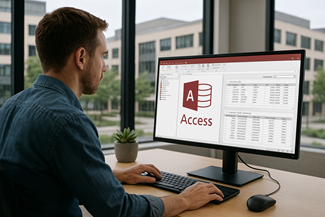
In Long Beach, a lot of work still runs on Microsoft Access. We see it in shipping and logistics, back-office billing, inspections, HR tracking, and internal reporting. When the database starts acting strange, the impact is immediate. People wait on reports, data starts drifting, and somebody says, “Let's just export it to Excel for now.”
MS Access Solutions helps Long Beach organizations fix and modernize Access databases without a disruptive rebuild. We repair broken forms and reports, correct data issues, and stabilize multi-user performance so your staff can work in the same file without constant locking and conflicts.
If you are hitting size limits or you need better speed, we can move the tables to SQL Server and keep Access as the front end. You get better reliability, better security options, and room to grow, while keeping the screens people already know. And yes, we will explain it in plain English, even if tihs is not your world.
The Best Microsoft Access Database Solutions owner, consultant, and principal programmer is Alison Balter – a recognized expert Microsoft Access consultant. Alison is the author of 15 Microsoft Access training books and videos. She is a frequent guest speaker at MS Access conferences and has developed hundreds of applications for businesses of all types.
We know your business data is important. We isten to your concerns, ask clarifying questions, and gather input from the people who use the system every day. Together we define what you need from your database, why certain features matter, and how staff actually works. From there we design the right table structure, queries, forms, dashboards, and reports so you get a stable system that supports real-world decision making.


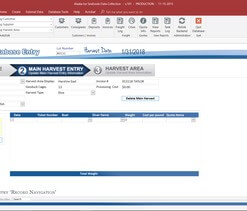





Access continues to be a highly efficient tool for business database development.
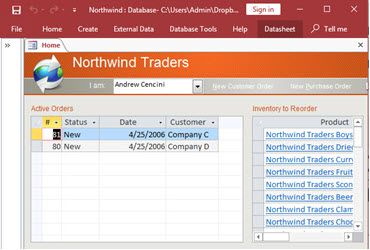
How to create a Microsoft Access application with some useful tips and best practices.
Your Access developer near you has practical advice on choosing and working with an Access consultant.
Call MS Access Solutions at (323) 285-0939 for your FREE consultation.
The material below originally appeared in Alison Balter's book Mastering Microsoft Office Access 2007 Development and is reprinted here with the author's permission. There may be references to "Figures" or "Chapters" that are not reprintable and are not used on this page.
The naming conventions for table names are similar to those for field names, except that the standard for table names is that they should begin with the tag tbl. Chapter 1, "Access as a Development Tool," and Appendix A, "Naming Conventions," (available for download at www.samspublishing.com) cover the details of naming conventions.
Field names can be up to 64 characters long. For practical reasons, you should try to limit them to 10–15 characters—enough to describe the field without making the name difficult to type.
Field names can include any combination of letters, numbers, spaces, and other characters, excluding periods, exclamation points, accents, and brackets. I recommend that you stick to letters. Spaces in field names can be inconvenient when you're building queries, modules, and other database objects. Don't be concerned that your users will see the field names without the spaces. The Caption property of a field, discussed later in this chapter, allows you to designate the text that Access displays for your users.
Field names cannot begin with leading spaces. As mentioned, field names shouldn't contain spaces, so this convention shouldn't be a problem. Field names also cannot include ASCII control characters (ASCII values 0 through 31).
Try not to duplicate property names, keywords, function names, or the names of other Access objects when naming your fields. Although your code might work in some circumstances, you'll get unpredictable results in others.
To make a potential move to the client/server platform as painless as possible, you should be aware that not all field types are supported by every back-end database. Furthermore, most back-end databases impose stricter limits than Access does on the length of field names and the characters that are valid in field names. To reduce the number of problems you'll encounter if you migrate your tables to a back-end database server, you should consider these issues when you're naming the fields in your Access tables.
Adding descriptions to your table, query, form, report, macro, and module objects goes a long way toward making your application self-documenting. This information helps you, or anyone who modifies your application, to perform any required maintenance on the application's objects. Chapter 29, "Documenting Your Application," covers the details of documenting your application.
It is important to be aware how the field names you select affect the potential for upsizing your tables to a client/server database. Database servers often have much more stringent rules than Access does regarding the naming of fields. For example, most back ends do not allow spaces in field names. Furthermore, most back ends limit the length of object names to 30 characters or fewer. If you create Access field names that cannot be upsized and later need to move your data to a back-end database server, you will increase the amount of work involved in the upsizing process. The reason is that you must modify any queries, forms, reports, macros, and modules that use the invalid field names to reference the new field names when you move your tables to a back-end database server.
The precediing information originally appeared in Alison Balter's book Mastering Microsoft Office Access 2007 Development and is reprinted here with the author's permission.
More Access programmer information is available on the Microsoft Access Programmer Oakland, California web page.
Answer: Yes. We start by reproducing the problem, then we check record locking, split-database setup, network paths, front-end distribution, and queries that cause table scans. Many “random” freezes come from a few predictable issues, and once they are corrected the file becomes stable again.
Answer: Yes. We routinely repair and modernize legacy Access databases. That can include updating references, replacing deprecated ActiveX controls, cleaning up VBA, and adjusting forms and reports so the file behaves well on newer Office builds.
Answer: If you are bumping into file size limits, you need better concurrency, or reporting is slow even after tuning, SQL Server is a smart next step. We can upsize the tables, keep Access as the front end, and improve performance without forcing users to learn a new interface.
Answer: Often, yes. We build reliable imports and exports, create links to external tables where it makes sense, and add validation so bad data does not silently slip in. If you are currently copying and pasting between systems, automation usually pays for itself quickly.
Answer: First we secure a safe copy and stop the cycle that caused the corruption. Then we compact and repair, rebuild damaged objects if needed, and add prevention steps like proper front-end deployment, stable links, and better error handling so the issue does not keep coming back.
Answer: Most projects start with a short diagnostic review. You will get a clear list of what is wrong, what matters first, and a practical plan. Some jobs are quick fixes. Others involve staged improvements, documentation, and ongoing support as the database grows.